
Naresh Kumar, International Journal of Social Impact
The other day my Yoga teacher while explaining the importance of pranayama commented that a person can live without food for a month, without food and water for ten days but without air, the person cannot survive for more than two minutes. A person will suffocate to death in two minutes if he/ she is prevented from breathing. Thus, breathing is more critical and important than eating food or drinking water.
We are hardly aware of breathing because it is our natural automatic process. We control our diet but we never think that it may be worthwhile to control how to breathe. We don’t see a need to observe our breathing as it goes on and on without a conscious effort. But we all have observed that after doing exercises (not Yoga) or running long distances, our breathing speed goes up, it also goes up when we are greatly emotionally charged. Emotional turbulence always results in increasing breathing speed as well as increasing heartbeats. When we are excessively frightened, we can hear our fast heartbeat along with increased short breaths. Also, the same thing happens when we are excessively agitated or furiously angry, our breathing speed goes up, and our heart rate goes up- we seem to lose control of our mental faculties and respond reflexively often losing threads of logic. Our face becomes red with fury and without thinking we act; this flares and aggravates the conflict. Conflict resolution is a technique which I had to use in my professional life as GM (operations) of various multilocational factories. I had occasions when a manager/officer will come to my office red with rage with a complaint against some officials. It was very disturbing to face such people when in a rage. The first thing that I did was to make him/ her drink a glass of water and then on some pretext or the other I digressed my communication with him on a topic not relevant to the conflict. I did this in order to bring him/ her into a state of receptive mind by cooling off the tempers and letting logical thinking get its place in the person’s mind. Only after the red face has lost its hue and the person returned to composure and could get control over their voice, did I start my conflict-resolving exercise. On the other hand, if I was agitated, I followed the principle of counting to 50 in my mind and then drinking a glass of water before reacting to the situation. In both cases, the mind was calmed before tackling the main issue.
Today after the Yoga class which taught me the importance of breathing, I realize that the calming of my mind was not because of my efforts of taking a break from the agitating situation but my all efforts did only one thing—made the person (in conflict cases) and me (in my agitated state) regain normal breathing. Normalized breathing, in turn, calms the mind and makes logical deliberations possible. At that time, I never realized that it is normalizing breathing which calmed the mind of agitated managers and mine when I was agitated. This fact dawned on me after my yoga training which lays maximum emphasis on breathing.
In the above discussions, I talked about the increase in the speed of breathing during exercises and I made an exception for yoga exercises. While in Gym our breathing speed and heart rate go up but the same amount of calorie burning in yoga exercises does not reflect in increased breathing speed or increased heartbeat. This is because all physical activities in yoga are done synchronizing exercises with breathing. Each physical movement is linked to inhaling and exhaling. Even during pranayama—the breathing exercises, our teacher time and again cautioned us not to use force but let breathing happen effortlessly. If the breathing during pranayama is accompanied by a sound, it means that the breathing is not effortless but is forced. We are taught to breathe without making a sound, i.e., do effortless breathing. Thus, even after one hour of yogic exercise, I never had an increased heartbeat or increased breath speed. Rather the exercises physically stretched the muscles but made the mind calmer.
I had gone for Yoga because of a paradox I was faced with. I was overweight and my diet controls were not helping me in reducing the weight. The option left was to do brisk walking and exercises but my knee pained and I could not walk. So, I had a paradox! Walk I should but walk I couldn’t due to knee pain!!
Someone suggested that I should go for yoga and they may have a solution. My yoga teacher was taking special classes for people like me suffering from physical pains- knee pain, backache and so on… He made me do exercises which strengthened my thigh and leg muscles and some exercises were done to pull muscles around the knees to create space around knee caps. These exercises helped me in walking and I could increase my daily steps from 6000 per day to over 12000 steps per day. I was amazingly happy over this miracle but as a side effect, I found myself calmer than before and this was because of proper breathing as taught by my yoga teacher.
A big takeaway from the above discussions is that proper breathing is very important as it calms the mind. Could there be more benefits of having good breath control? My yoga teacher’s classroom lecture on breathing prompted me to explore this aspect of breathing and here I am with this paper.
This paper would explore the benefits of controlled breathing. We shall deal with the subject in a structured manner. We shall learn what is breathing, what are different types of breathing, what is meant by controlled breathing, and how it can be done. We shall explore what benefits accrue if we make it our natural habit to have controlled breathing. In this context, we shall discuss Yoga also which is rich with knowledge on breath and mind control.
What is breathing
Vedantu1 defines breathing as follows
Breathing is the process where the oxygen from the environment is utilized to break down food and help in providing us with energy. Breathing involves the intake of oxygen and the expiration of carbon dioxide and thus is the most crucial process. The process of respiration is controlled by different parts of the body. The action of breathing is an involuntary action. A normal human or adult breathes 12-16 times per minute. The process of inspiration lasts for around 2 seconds and the process of expiration lasts for around 3 seconds. According to the needs of the body, the rate and amount of breathing can be controlled.
Air moves in and out of the lungs in response to differences in pressure. When the air pressure within the alveolar spaces falls below atmospheric pressure, air enters the lungs (inspiration), provided the larynx is open; when the air pressure within the alveoli exceeds atmospheric pressure, the air is blown from the lungs (expiration). Larynx is the voice box and is in the form of a hollow tube in the respiratory system. Alveolar spaces are spaces between alveoli. Alveoli are tiny, balloon-shaped air sacs in your lungs. The function of the alveoli is to move oxygen and carbon dioxide (CO2) molecules into and out of your bloodstream.
The flow of air is rapid or slow in proportion to the magnitude of the pressure difference. Because atmospheric pressure remains relatively constant, flow is determined by how much above or below atmospheric pressure the pressure within the lungs rises or falls.
Alveolar pressure fluctuations are caused by the expansion and contraction of the lungs resulting from tensing and relaxing of the muscles of the chest and abdomen. Each small increment of expansion transiently increases the space enclosing lung air. There is, therefore, less air per unit of volume in the lungs and pressure falls. A difference in air pressure between the atmosphere and lungs is created, and air flows in until equilibrium with atmospheric pressure is restored at a higher lung volume. When the muscles of inspiration relax, the volume of the chest and lungs decreases, lung air becomes transiently compressed, its pressure rises above atmospheric pressure, and flow into the atmosphere results until pressure equilibrium is reached at the original lung volume. This, then, is the sequence of events during each normal respiratory cycle: lung volume change leading to pressure difference, resulting in the flow of air into or out of the lung and establishment of a new lung volume.
In respiration or breathing, the air gets into the lungs and oxygen is absorbed and in the exhaled air carbon dioxide is released into the environment. Reverse is the process in plants where intake is carbon dioxide and exhalation are oxygen.
Additional information on breathing is provided by Rebecca Dezube3
Breathing is usually automatic, controlled subconsciously by the respiratory centre at the base of the brain. Breathing continues during sleep and usually even when a person is unconscious. People can also control their breathing when they wish, for example during speech, singing, or voluntary breath- holding. Sensory organs in the brain and in the aorta and carotid arteries monitor the blood and sense oxygen and carbon dioxide levels. Normally, an increased concentration of carbon dioxide is the strongest stimulus to breathe more deeply and more frequently. Conversely, when the carbon dioxide concentration in the blood is low, the brain decreases the frequency and depth of breaths. During breathing at rest, the average adult inhales and exhales about 15 times a minute.
Rebecca says that breathing can be controlled as per our wish and later in the paper, we shall see how we can do that and what are the benefits of controlling breathing. She highlights the various parts of the body that help in breathing.
The work of breathing is done by the • Diaphragm
- Muscles between the ribs (intercostal muscles)
- Muscles in the neck
- Abdominal muscles
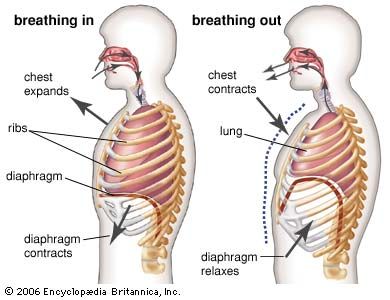
The diaphragm, a dome-shaped sheet of muscle that separates the chest cavity from the abdomen, is the most important muscle used for breathing (called inhalation or inspiration). The diaphragm is attached to the base of the sternum, the lower parts of the rib cage, and the spine. As the diaphragm contracts, it increases the length and diameter of the chest cavity and thus expands the lungs; when the diaphragm contracts and moves lower, the chest cavity enlarges, reducing the pressure inside the lungs. To equalize the pressure, air enters the lungs. When the diaphragm relaxes and moves back up, the elasticity of the lungs and chest wall pushes air out of the lungs.
The intercostal muscles and neck muscles help move the rib cage and thus assist in breathing. Abdominal muscles are sometimes involved in breathing out. The process of breathing out (called exhalation or expiration) is usually passive when a person is not exercising. The elasticity of the lungs and chest wall, which are actively stretched during inhalation, causes them to return to their resting shape and to expel air out of the lungs when inspiratory muscles are relaxed. Therefore, when a person is at rest, no effort is needed to breathe out. During vigorous exercise, however, a number of muscles participate in exhalation. The abdominal muscles are the most important of these. Abdominal muscles contract, raise abdominal pressure, and push a relaxed diaphragm against the lungs, causing air to be pushed out.
The above discussion explains the various basics of breathing. The basic function of breathing is to take oxygen from the environment and utilize it to break down food and help in providing us with energy. It also involves taking out carbon dioxide from the body and releasing it into the atmosphere through the process of exhaling. It is an automatic and involuntary action where the intake of air and release of air gets done automatically as the air moves in and out of the lungs in response to differences in pressure. The different parts of the body involved in breathing are the nostrils, windpipe, Larynx, lungs, alveoli in lungs, chest rib cage, diaphragm, muscles between the ribs (intercostal muscles), muscles in the neck and abdominal muscles. The mechanism of automatic pressure builds and its release to govern inhaling and exhaling is elaborately explained in the above paragraphs.
Another aspect related to breathing is its correlation with the nervous system. Brianna Majsiak Claire Young has some details4:
“One well-researched breath work technique is diaphragmatic breathing. What makes it special is the way it can influence the entire body, especially the nervous system, according to a study published in June 2018 in Cureus. When we are under stress — whether running from a predator or dealing with a particularly frustrating email — the brain turns on the sympathetic nervous system (SNS), which governs the flight, fight, or freeze response. You’ll notice the activation of your SNS if you have shallow breathing, tense shoulders, increased blood pressure, or an upset stomach.
Countering the SNS is the parasympathetic nervous system (PNS), or the rest- and-digest response: essentially, your body is in a state of calm. Hawkes and Taylor both describe a process called thalamic gating, which according to the Encyclopedia of Clinical Neuropsychologyis when the executive functions of the brain get turned off to aid in escaping danger. These functions may also be deactivated by diaphragmatic breathing, according to a study published in October 2020 in Medicines, which posits that deep breathing may act as a manual switch to move your system from the SNS into the PNS. In other words, from a state of stress to a state of calm.
For example, when you release tension with a big sigh or exhalation, you may be able to reverse the fight-or-flight response and slip into a state of relaxation. “A sigh of relief releases carbon dioxide and literally changes the biochemistry in your brain,” explains Taylor.”
More details on breathing, the nervous system and the brain is provided by an article in Vedantu1
Nervous Regulation-As the name suggests, the rate of breathing is controlled by the nervous system. Various respiratory centres are present in the brain and they are responsible for the control of breathing human respiratory system. There are a group of neurons that are present in the brain and they are named medulla oblongata and pons.
They help in controlling the rate and depth of breathing. Respiration is
controlled by two centres that are:
- Respiratory Rhythm Centre: This centre is present in the medulla region of
the hindbrain. It is a specialized centre that helps in the control of respiration. According to the neurons, it helps in controlling the activity of inspiration or expiration. This happens when the neurons are activated. This control of breathing takes place according to the need of the body. - Pneumotaxic Centre: In the pons region of the hindbrain this centre is present. It is the respiratory rhythm centre, which means that this centre is responsible for controlling or setting up the rhythm of breathing. The rate of breathing is controlled by sending nerve impulses that can increase or decrease the amount of inspiration and expiration. This helps in affecting the overall respiration rate.
The above gives us some insight into the working of the nervous system and brain during breathing and the rhythm of breathing.
We know that while it is an automatic and involuntary process yet we can control the rhythm of breathing i.e., we can practice control over breathing. We can make breathing slow, deep and long. With practice, we can regulate our breath as per our wishes. We shall soon come to this topic but before that, we shall examine types of breathing. We saw that breath becomes fast when we are emotionally disturbed and we can slow down the breath. So, breath could be fast/slow, deep/ shallow, or long/short. Thus, there can be several types of breathing. In the next paragraphs, we shall explore the types of breathing: - Types of Breathing
Libretext Biology4 makes mention of four types of breathing:
There are different types, or modes, of breathing that require a slightly different process to allow inspiration and expiration. All mammals have lungs which are the main organs for breathing. Lung capacity has evolved to support the animal’s activities. During inhalation, the lungs expand with air and oxygen diffuses across the lung’s surface, entering the bloodstream. During exhalation, the lungs expel air and lung volume decreases. The various types of breathing, specifically in humans, include:
1) Eupnea: a mode of breathing that occurs at rest and does not require the cognitive thought of the individual. During eupnea, also referred to as quiet breathing, the diaphragm and external intercostals must contract.
2) Diaphragmatic breathing: a mode of breathing that requires the diaphragm to contract. As the diaphragm relaxes, air passively leaves the lungs. This type of breathing is also known as deep breathing. During inhalation, the diaphragm is contracted which increases the volume of the lung cavity. During exhalation, the diaphragm is relaxed which decreases the volume of the lung cavity.
3) Costal breathing: a mode of breathing that requires contraction of the intercostal muscles. As the intercostal muscles relax, air passively leaves the lungs. This type of breathing is also known as shallow breathing.
4) Hyperpnea: a mode of breathing that can occur during exercise or actions that require the active manipulation of breathing, such as singing. During hyperpnea, also known as forced breathing, inspiration and expiration both occur due to muscle contractions. In addition to the contraction of the diaphragm and intercostal muscles, other accessory muscles must also contract. During forced inspiration, muscles of the neck, including the scalenes, contract and lift the thoracic wall, increasing lung volume. During forced expiration, accessory muscles of the abdomen, including the obliques, contract, forcing abdominal organs upward against the diaphragm. This helps to push the diaphragm further into the thorax, pushing more air out. In addition, accessory muscles (primarily the internal intercostals) help to compress the rib cage, which also reduces the volume of the thoracic cavity.
A paper in Core walking magazine by a yoga teacher5 gives the following four types of breathing:
- Diaphragmatic– On every inhale the diaphragm muscle is designed to lower minimizing the space in the abdominal cavity. This is why the belly pushes out with an inhale and why this is sometimes referred to as belly breathing.
- Thoracic– If the diaphragm doesn’t descend when we inhale the chest must expand
to accommodate the air that has been sucked into the lungs.
There is nothing wrong with employing thoracic breathing by choice. Certain types of yoga use it all the time. But we don’t want it to be our default breathing pattern.
• Clavicular– Most people don’t realize just how much space the lungs take up in the body. The top of each lung is above the collarbone or clavicle. Clavicular breathing uses the whole lung and is mostly called upon during extreme exercise such as
running marathons.
• Paradoxical– is a strange breathing occurrence where the chest compresses on the inhale rather than expands, in reverse of the normal movements.
The variation in breathing patterns is seen in the above types of breathing. Slow breathing is preferable. Amarjit Singh6 quotes Swami Sivananda-Yogi measures the span of life by the number of breaths, not by the number of years. Every person has a fixed length of life. It means that the number of breaths allotted to a person is fixed and it is up to the person to consume this number of breaths in a short time or extend it to a longer span. If we breathe faster, we shall consume the breath quota in a shorter period of time and hence we shall live for a smaller number of years. Contrarily if a breath takes a longer time to complete, we shall extend our lives by many years. It is said that normally a person takes 15-16 breaths in a minute and the life span is 70 years. If the person takes only 10 breaths in a minute the life span would extend to 100 years. Hence, we should control our breathing so that breathing takes a longer time to complete. We must take slow long breaths if we want to live longer. Can we slow our breathing; can we control our breathing i.e, can we achieve breath control? We shall explore the answer but before that let us first understand what is meant by controlled breathing.
Meaning of controlled breathing—breath control
We have observed that irregular breathing happens when we have a disturbed mind and contrarily while doing yoga when we have regularized breathing the mind is calmer. It means that we can control our breathing as done in yoga. Breath control would mean the ability to control breathing speed and duration. Automatic involuntary breathing has a particular speed and duration but we can change the speed and duration of breath as per our wish. Slow, deep and long breath is considered best and pranayama attempts to bring this breath control.
As we said people can control their breathing when they wish, for example, we can find these controls during a speech, singing, or voluntary breath holding. Breath is controlled during a speech by synchronizing breathtaking only during a pause in the flow of words i.e., many times breath is taken at the short interval because the pause comes quickly and sometimes there is a long delay for taking the next breath because the flow of words keep going for a longer time and then a pause comes. The same is the case with singing.
It is imperative that a singer is able to grab a good, whole breath in a fraction of a second and use it to support the voice in such a way that you are not straining to keep pushing out a song. A singer has to delay breathing till the stanza of the song is over and music takes over. The stanzas could be short or long and consequently, the breath could be at short intervals or one has to hold breath for a longer time.
During yoga, we control our breath using voluntary breath-holding techniques and can make breath slow, longer and deeper. In this paper, we shall be concentrating on breath control which makes our breath slow, long and deep and by controlled breathing, we shall be meaning slow,
deep and long breathing.
To make it a habit to have controlled breathing, we have to continuously make efforts by doing breathing exercises. In the next paragraphs, we shall explore how can we go about making our breathing slow, deep and long i.e., how to achieve controlled breathing.
Moving towards Controlled Breathing
Some useful tips for controlling our breathing are given below:
- To practice breathing control you should be in a comfortable, well- supportedposition.
- Gently rest one hand on your stomach, keeping your shoulders and upper chest relaxed. Allow your hand to rise gently as you breathe in. If you imagine air filling the abdomen like a balloon inflating this may help. If possible, breathe in through your nose.
- Feel your stomach rise gently and then let the air sigh out. It is important thatbreathing out is relaxed.
- Ensure your neck and shoulders remain relaxed
- Gradually try to increase the depth of your breathing whilst maintaining relaxation
- By doing this you can make your breathing more efficient, thus reducing
yourbreathing rate.
Mastering breathing control doesn’t happen easily. It involves trying to retrain the way you breathe – often against years of habit. (source: Physiotherapy Department, Reference No: 5245-2Issue date: 1/3/21 file:///C:/Users/admin/Downloads/5245-2Breathing-Control.pdf ) - Breathing is a self-regulated process and it continues without any conscious effort. We breathe in sleep as well as even when we are unconscious. But controlled breathing needs an effort.
Brianna Majsiak and Claire Young7 give similar tips for doing deep breathing
Take It Easy at the Start-“The most important thing is to start slow, start small, and work your way up. You want to condition your nervous system,” explains Hawkes. “You can’t go run a marathon when you haven’t run a mile.” She says beginners should set a timer for one minute and avoid long meditations. Increase the time as you get used to breathwork.
Move the Breath to the Belly-Deep breathing won’t make your shoulders or upper chest move dramatically. A sign that you’re engaging your diaphragm is that your lower abdomen is filling and emptying. Place a hand on your belly and practice pushing it in and out.
This type of breathing can also be performed sitting up or lying on your back.- Start with your hands resting on your belly, just below the navel. As you breathe in, let your belly soften and expand like a balloon. When
you breathe out, let your belly sink toward your spine. - Place one hand on your ribs and the other on your belly. Breathe in
slowly, let your belly soften, and feel your ribs expand. - Move the hand that was on your ribs to your upper chest, just below the
collarbone. As you inhale, allow your belly to soften, your ribs to expand, and
your upper chest to broaden. As you exhale, let everything go.
It is recommended to take three to five (or up to 10) of these deep breaths every morning before you get out of bed, again anytime during the day when you’re stressed out, and again before you go to sleep at night. Do this every day for three weeks. “You might get bored, you might wonder why,” she says, “but stick with it because over time your limbic brain will begin to respond to your mindfulness and breath.
- Start with your hands resting on your belly, just below the navel. As you breathe in, let your belly soften and expand like a balloon. When
These breathing exercises will gradually take you towards deeper breathing and it may become a natural way of breathing where after a stage you may not have to make a conscious effort for this. This is something like learning to ride a bicycle; at the initial stage you have to make a lot of effort but over a period of time it becomes effortless and natural.
McKenna Princing8 has more to say on deep breathing-
Deep breathing can help lessen stress and anxiety.
1. Pursed lip breathing
You can practice pursed lip breathing at any time. It may be especially useful during activities such as bending, lifting, or stair climbing.
To do it:
- Relax your neck and shoulders.
- Keeping your mouth closed, inhale slowly through your nose for 2
counts. - Pucker or purse your lips as though you were going to whistle.
- Exhale slowly by blowing air through your pursed lips for a count of 4.
2. Diaphragmatic breathing
Diaphragmatic breathing (aka belly breathing) can help you use your diaphragm properly. Do belly breathing exercises when you’re feeling relaxed and rested.
A 2020 meta-analysis Trusted Source shows this type of breathing is particularly helpful in people with breathing challenges due to chronic obstructive pulmonary disease (COPD), heart problems, or cancer. It may also help reduce stress and help with challenges related to eating disorders, constipation, high blood pressure, migraine episodes, and other health conditions.
The method of doing this breathing is - Lie on your back with your knees slightly bent and your head on a pillow.
- You may place a pillow under your knees for support.
- Place one hand on your upper chest and one hand below your rib cage, allowing
you to feel the movement of your diaphragm. - Slowly inhale through your nose, feeling your stomach pressing into your hand.
- Keep your other hand as still as possible.
- Exhale using pursed lips as you tighten your abdominal muscles, keeping your
upper hand completely still.
You can place a book on your abdomen to make the exercise more difficult. Once you learn how to do belly breathing lying down, you can increase the difficulty by trying it while sitting in a chair. You can then practice the technique while performing your daily activities.
3. Breath focus technique
This deep breathing technique uses imagery or focuses on words and phrases. You can choose a focus word that makes you smile, feel relaxed, or is simply neutral. Examples include peace, let go, or relax, but it can be any word that suits you to focus on and repeat through your practice.
As you build up your breath focus practice, you can start with a 10-minute session. Gradually increase the duration until your sessions are at least 20 minutes.
To do it: - Sit or lie down in a comfortable place.
- Bring your awareness to your breaths without trying to change how you’re breathing.
- Alternate between normal and deep breaths a few times. Notice any differences between normal breathing and deep breathing. Notice how your abdomen expands with deep inhalations.
- Note how shallow breathing feels compared to deep breathing.
- Practice your deep breathing for a few minutes.
- Place one hand below your belly button, keeping your belly relaxed, and notice how it rises with each inhales and falls with each exhale.
- Let out a loud sigh with each exhale.
- Begin the practice of breath focus by combining this deep breathing with imagery and a focus word or phrase that will support relaxation.
- You can imagine that the air you inhale brings waves of peace and calm throughout your body. Mentally say, “Inhaling peace and calm.”
- Imagine that the air you exhale washes away tension and anxiety. You can say to yourself, “Exhaling tension and anxiety.”
4. Lion’s breath
Lion’s breath is an energizing yoga breathing practice that is said to relieve tension in your chest and face.
It’s also known in yoga as Lion’s Pose or Simhasana in Sanskrit.
To do this: - Come into a comfortable seated position. You can sit back on your heels or cross your legs.
- Press your palms against your knees with your fingers spread wide.
- Inhale deeply through your nose and open your eyes wide.
- At the same time, open your mouth wide and stick out your tongue, bringing the tip down toward your chin.
- Contract the muscles at the front of your throat as you exhale out through your mouth by making a long “haaa” sound.
- You can turn your gaze to look at the space between your eyebrows or the tip of your nose.
- Do this breath 2 to 3 times.
5) Resonant or coherent breathing
Resonant breathing, also known as coherent breathing, is when you breathe at a rate of 5 full breaths per minute. You can achieve this rate by inhaling and exhaling for a count of 5.
Breathing at this rate maximizes your heart rate variability (HRV), reduces stress, and, according to one 2017 study, can reduce symptoms of depression when combined with Iyengar yoga.
To do this: - Inhale for a count of 5.
- Exhale for a count of 5.
- Continue this breathing pattern for at least a few minutes.
6. Deep breathing
Deep breathing helps to relieve shortness of breath by preventing air from getting trapped in your lungs and helping you to breathe in fresher air. It may help you to feel more relaxed and centred.
To do this:
- While standing or sitting, draw your elbows back slightly to allow your chest to expand.
- Take a deep inhalation through your nose.
- Retain your breath for a count of 5.
- Slowly release your breath by exhaling through your nose.
The above discussions bring into focus various types of breathing including controlled breathing (Slow deep and long breathing) which help us in various ways. Most of these breathings have been inspired by Yoga. We shall be describing yogic breathing elaborately at the end of this paper. But before that let us look at the benefits of controlled breathing.
Benefits of controlled breathing
We discussed Swami Sivananda’s assertion that as per yogis the span of life is determined by
the number of breaths and not by the number of years i.e., each person is allotted a fixed number of breaths which determines his life span. If breaths are short and taken at high speed, we tend to consume our quota of breaths in a few years but if we are careful and take long breaths, the time taken for consuming the same quota of breaths will need many more years and life span will increase. It is said a person normally takes 15 breaths in a minute and at this rate of breathing, the average life expectancy is 70 years. But by controlled breathing if we take longer breaths and take only 10 breaths in a minute, we can live up to 100 years i.e., our life span can increase by 30 years.
Simply stated, controlled breathing adds years to our life. This is the most vital benefit accruing out of controlled breathing.
Deep abdominal breathing encourages full oxygen exchange — that is, the beneficial trade of incoming oxygen for outgoing carbon dioxide. Not surprisingly, it can slow the heartbeat and lower or stabilize blood pressure. (Source: https://www.health.harvard.edu/mind-and- mood/relaxation-techniques-breath-control-helps-quell-errant-stress-response)
The above is confirmed personally by me during the yoga classes that I attended. After doing the deep breathing exercises, my mind became calmer and could feel a slow rhythmic heartbeat I am sure that the blood pressure also must have stabilized. While driving back from the class, I could enjoy the calm sensation caused by the deep breathing. Normally uneasiness perturbs my mind because after retirement there is not much to do and idle hours pester my mind. But after deep breathing exercises, blissful calmness filled enjoyment in my calm mind and I could concentrate better on all activities. This lasted for more than one hour. I wonder if deep breathing exercises could take me to blissful mental calmness, maybe if deep breathing is made a habit, this mental calmness may become my way of life. I did explore how to move towards making deep breathing a regular normal habit and I shall discuss the same, but before that let us look at some more benefits of breath control.
Susan Fishman10 lists down many benefits of breath control through diaphragm breathing i.e., deep breathing
Using the diaphragm correctly while breathing has many benefits. It can help by:
- lowering blood pressure
- increasing oxygen levels in the blood and tissues
- decreasing stress
- distracting from pain
- improving concentration
Diaphragmatic breathing can help with certain conditions
Researchers are still studying the effects of diaphragmatic breathing on health. A 2022 review highlights studies on its use in treating various health conditions, including:- stress
- anxiety
- COPD (chronic obstructive pulmonary disease)
- asthma
- gastrointestinal (GI) conditions
- eating disorders
- hypertension
- migraine
Research also suggests that diaphragmatic breathing may improve the quality of life for people with cancer and boost cardiorespiratory fitness in those with heart failure.
Stress and anxiety-Feeling stressed or anxious causes the heart rate to increase, the muscles to tense up, and breathing to become shallow. Diaphragmatic breathing helps deepen your breathing, encouraging your body to relax. A 2019 review of three studies indicate that diaphragmatic breathing may decrease stress. These studies looked at physiological markers of stress, as well as psychological self-reports from the participants.
COPD (chronic obstructive pulmonary disease)- Diaphragmatic breathing helps increase respiratory function in people with COPD. If you have COPD or asthma, the lungs can trap air inside, making it more difficult to breathe. You gradually use other muscles in your upper body to breathe, which is not as efficient as belly breathing.
- stress
As the ALA (American Lung Association) explains, diaphragmatic breathing strengthens the diaphragm so that you can more forcefully exhale stale air. This increases oxygen levels and helps you be more active. Gastrointestinal conditions- For people with GI symptoms, such as diarrhoea and constipation, diaphragmatic breathing is a possible complementary therapy. Activating the diaphragm facilitates the relaxation response, known as the “rest-and-digest” state.
Belly breathing affects pressure inside the abdomen, “massaging” internal organs. This can help reduce abdominal pain, bloating, and constipation. Additionally, a small randomized controlled trial showed that relaxed breathing techniques increased quality of life scores for people with irritable bowel syndrome.
Thus, we see tremendous benefits of a simple action i.e., deep breathing. Not only it improves physical/mental health, but it also assists in the cure of many diseases and above all, it adds years to your life.
We all know that every system in the body relies on oxygen. Deep breathing brings in an ample quantity of oxygen into the system which improves cognition as well as digestion. It also gives a greater sense of mental clarity, helps you sleep better, digest food more efficiently improves your body’s immune response, and reduces stress levels.
Some additional benefits of diaphragmatic: Diaphragmatic breathing helps a person engage the diaphragm fully while breathing. This may provide a number of health benefits,
including:
- strengthening the diaphragm
- improving stability in the core muscles
- slowing the breathing rate
- lowering heart rate and blood pressure
- promoting relaxation
(Source-https://www.medicalnewstoday.com/articles/diaphragmatic-breathing)
Two more benefits of deep breathing are being added from a paper by Becky Upham11 - Relieves some symptoms of irritable bowel syndrome (IBS)
There can be digestive benefits of deep breathing, says Megan Elizabeth Riehl clinical assistant
professor and health psychologist at the University of Michigan Health in Ann Arbor. “The
physiological movements of the diaphragm can help relieve tension in the digestive tract and can help with GERD (gastroesophageal reflux disease) symptoms, constipation, diarrhoea, and urgency,” she says.
Lin agrees that deep breathing may help with these symptoms because tension can interfere with good digestion.
A small study published in April 2020 in Frontiers in Psychiatry in adults with IBS that included training in progressive muscle relaxation and diaphragmatic breathing found that compared to wait-list control, the intervention led to improvements in IBS symptoms, depression, and quality of life.
Reduces The Number and Severity of Hot Flashes
High levels of cortisol, one of the fight or flight stress-related hormones, have been linked to hot flashes, a menopause symptom, according to a study published in April 2017 in Maturitas.
There is some evidence that paced breathing — deep, slow breathing at a rate of 6 to 8 breaths per minute — may help reduce hot flashes.
Hot flashes can also occur as a side effect of some cancer treatments. Memorial Sloan Kettering Cancer Center recommends deep breathing exercises as a nonhormonal way to help reduce the severity or number of hot flashes.
There are many vital benefits of controlled breathing as illustrated above and these can be harnessed by mastering controlled breathing through breathing exercises which bring controlled breathing into a routine in our breathing. Breathing exercises also have been discussed in detail which help in deep controlled breathing. All the breathing exercises have their roots in Yoga.
We shall conclude the paper after discussing the yogic breathing exercises and the benefits that accrue from them.
Breathing exercises in Yoga
Having undergone Yoga classes, I can emphatically vouch for the tremendous benefits I could harness through the yoga exercises including the breathing exercises. I had dwelt on these in the introductory stage of the paper and hence I shall not repeat the same. We shall now look at Yogic breathing exercises. Lauren Hellicar 12 while explaining yoga breathing says:
Yogic breathing is intentional, controlled breathing that is an essential part of yoga.
Yoga is an ancient trusted source practice from India that involves working with the mind, body, and breath to calm the fluctuations of the mind. Its basis is the yoga sutras, which are ancient Sanskrit texts that describe yoga and its underlying philosophy.
The breath aspect of yoga is known as pranayama in Sanskrit. “Prana” means “life force”, while “ayama” means “stretching.” Yoga practitioners use the breath to calm the mind, and the physical postures help them to focus on the breath. Some yogic breathing techniques are given hereunder:
Yogic breathing techniques
The sutras, which are the ancient texts that describe yoga, set out different breathing techniques for different purposes.
Scientific studies backing the claimed benefits for each individual technique are sparse. Different teachers may also have slightly different approaches.
Three-part breath (Drigha Pranayama)
The three-part breath, or full yogic breath, involves using the nose, chest, and belly to fully inhale and exhale.
To practice this breathing exercise:
- Sit cross-legged on the floor or upright in a chair, with a tall spine. Take a few natural breaths in and out through the nose. Close the eyes if it is comfortable to do so.
- Breathing through the nose, take in a third of one’s full lung capacity deep into the diaphragm, expanding the belly. Breathe in the next third into the rib cage. Breathe in the final third into the upper chest.
- Release the breath through the nose, in reverse order; emptying first the chest, then the ribcage, then the belly. Continue for up to 10 rounds before returning to the breath’s natural rhythm.
Alternate nostril breathing (Nadi Shodhana/ Anulom Vilom)
Alternate nostril breathing features on the American Council on Exercise (ACE) list of stress- relieving breathing techniques. To practice this calming technique:
Ocean breath (Ujjayi)
Ujjayi breathing takes practice to master. Practitioners believe it helps to ground a person as well as provide heat energy for physical yoga practice.
To begin, inhale deeply through the nose, then constrict the back of the throat while breathing out. This should make a sound similar to the waves rolling on the ocean.
Another way to develop this technique involves breathing out with the mouth open as if fogging up a mirror with the breath to clean it. Once a person has mastered the Ujjayi exhale, they can aim to keep that same constriction of the throat during the inhale. The full breath cycle then becomes like the continuous flow of ocean wave sounds.
Some more yogic exercises:
Bhramari:
The name of this pranayama translates to ‘large bee’. This is because it involves making a buzzing sound while exhaling. Practising Bhramari calms the nerves as the vibrations of the sound you produce to create a state of homeostasis for your body. Do it in these steps
- Sit with your legs crossed and back straight but relaxed.
- Inhale deeply through your nostrils.
- Exhale while making a buzzing sound.
- Make the sound as loud as you can without exerting yourself.
- Repeat for 5 minutes and then lie down in Shavasana (lie on your back, and relax
while breathing normally).
Sahita Pranayama:
With this pranayama, you go into the state of Kumbhaka (suspended breath) which improves physical and mental endurance. The stillness that you feel elevates anxiety. Follow these steps,
- In a relaxed seated position, inhale naturally but focus on your breath.
- Hold your breath, but release it as soon as you feel discomfort.
- Exhale naturally and hold for a moment to experience the stillness.
- Do this for up to 5 minutes.
(source-https://www.adityabirlacapital.com/healthinsurance/active-together/2020/08/25/3- yoga-breathing-exercises-you-should-practise-daily/)
Another few
Bhastrika Pranayama or the Bellows Breath
- Sit in the Lotus Position with your back straight.
- Take a deep breath through your nose, filling your lungs with air. Then, breathe out in
the same manner. Do this a few times to settle your head. - After that, begin to exhale quick breaths through your nose forcefully. Follow it up by
inhaling in the same manner. - Your breath should come from your diaphragm, and your belly must move in and out
as you breathe. The rest of your body should be still. - Do a round of bellow breathing, following it up with natural breathing, and then go for the next round. As you breathe naturally, observe the sensations in your body and mind.
- Do at least 3 rounds of Bhastrika and end the session.
Kapal Bharati or the Skull Shining Breath - Sit in Sukhasana and place your palms on your knees. Focus on your belly region.
- Inhale deeply through your nose, filling your lungs with air. Breathe in calmly and
consciously. - Pull your stomach in towards your spine. Place your hand on the stomach and feel the
muscles contracting. - As you relax from the contraction, exhale in a short and quick burst. There will be a
hissing sound while you do so. There is automatic inhalation following that. - Practice one round of Kapalbhati which consists of inhaling and exhaling 20 times.
After one round, close your eyes in Sukhasana and observe your body.
Bahya Pranayama - Sit straight in Padmasana or Vajrasana
- Inhale deeply and exhale completely
- Hold your breath there while you pull your stomach up and drop your neck towards
your chest while lifting the chest to the chin. Hold on to this position for 5 to 10 seconds.
Then, inhale deeply and release your chin and stomach. - Repeat this process for about 5 minutes
o (source:https://www.stylecraze.com/articles/deep-breathing-exercises-for-you- to-try/)
So much so for the yogic breathing exercises.
Let us conclude the paper with the benefits of Yogic breathing. - Benefits of Yogic Breathing
Lauren Hellicar 12 lists down some benefits of Yogic Breathing
Research links a range of health benefits to the practice of yogic breathing. - Physical health
The authors of a 2020 study Trusted Source systematically reviewed 18 controlled trials on pranayama. They found evidence that it has significant benefits for people with respiratory illnesses.
For example, people with chronic obstructive pulmonary disease (COPD) showed improvements in their symptoms and the impact of the disease. The researchers also found evidence of a significant benefit to the circulatory and respiratory systems of people with asthma.
Mental Health
A 2020 randomized controlled trial examined the effects of a specific yogic breathing training program known as Bhastrika Pranayama. After 4 weeks of pranayama practice, participants showed significantly reduced states of anxiety and negative affect.
At the same time, they showed signs of changes to parts of the brain involved in emotional processing, attention, and awareness.
An older 2016 study Trusted Source highlighted a range of mental health benefits for people participating in a yogic-breathing-based life skills workshop for young adults. The participants reported:
- less stress
- fewer symptoms of clinical and subclinical depression and anxiety
- fewer symptoms of post-traumatic stress
- reduced impulsivity
- reduced tobacco use
- The researchers also found evidence of increased calm, mental focus, emotion regulation, and general well-being.
Having explored the general physical and mental benefits of yogic breathing, we shall see yogic exercise-wise benefits in the following paragraphs:
Shirin Mehdi13 gives benefits from Pranayama and from each of its breathing exercises:
You can control the life energy within you through Pranayama and attain
a healthy body and mind. The yogic sage Patanjali mentions Pranayama in his text ‘Yoga Sutra’ as an ideal means to attain Samadhi, the highest state of meditative consciousness. It takes energy into your body and flushes out the waste from your body and mind. The Pranayama process involves the retention of breath in the body along with inhaling and exhaling.
Retention of breath helps in increasing the energy of your body and distributing it throughout your body.
Let us see the benefits accruing out of pranayama breathing exercises:
Bhastrika Pranayama is a cleansing kriya that clears your nadis, nostrils, and sinuses and prepares you for deep breathing. It is also perfect for energizing your body. So, the next time you feel dull and lifeless, instead of reaching for a coffee, try Bhastrika Pranayama. Its major benefits are:
o Bhastrika Pranayama strengthens your lungs and helps in curing asthma
o It calms your mind and keeps allergies at bay
o The breathing exercise purifies your breath and improves your heart health
o It treats the common cold and is good for your immune system
o It brings tranquillity and peace to your mind
Kapal Bharati is a ‘shat’ kriya that flushes out toxic air from your body. The word ‘Kapalbhati’ means shining head. Kapal’ means forehead and ‘Bhati’ means shining. Its benefits are:
o Kapalbhati improves the functioning of your liver and kidneys o It gets rid of dark circles and reduces eye strain
o The process calms your brain and rejuvenates your body
o It eliminates acidity and gas-related problems
o The breathing technique improves your memory and concentration power
Bhramari is a simple breathing technique that can be practised anywhere as a quick solution to de-stress. The exhalation during this process is similar to the humming of a bee, which explains its name. Its benefits are:
o Bhramari Pranayama treats hypertension and reduces anger and anxiety o It helps reduce migraines and build confidence
o It reduces blood pressure and is good for Alzheimer’s disease
o The technique calms your nerves and reduces frustration
o It gives you a clear voice and reduces throat problems
Anulom Vilom or Alternate Nostril Breathing is a technique through which nadis, energy passages in your body, are cleared. Through Anulom Vilom’s alternate breathing pattern, the right and left nadis are cleansed, stimulated, and balanced. Its
benefits are:
o Anulom Vilom enhances your overall health
o It streamlines your metabolism and controls diabetes o It reduces arthritis and sinusitis
o The technique solves eye and ear issues
o It helps cure allergies and asthma
Bahya Pranayama or the External Breath is named as it involves retaining the breath after exhaling. As the breath is kept out, it is called the External Breath. ‘Bahya’ means external. It is a three-step process of inhaling, exhaling, and retaining the breath. Its benefits are:
o Bahya Pranayama cures hernias and acidity
o It cures urinary and reproductive problems
o It increases concentration and helps attain enlightenment o The technique prevents constipation and gastric problems o It cures diabetes and prostate-related problems
With this, we come to the end of the paper. I think the contents will create good awareness among the readers about the importance of breath and controlled breathing. Breathing, as is evident, is vitally important because we can’t live without it and controlled breathing helps us increase our life span and life gets full with vigour and health.
I conclude by saying that our breath control can come as an aid to good living and if we do not control our breath, the breath will control us and create friction, tension, anxiety, frustration, fatigue and even disease. (https://motherhoodcommunity.com/20-quotes-that-will-make-you- want-to-breathe-more-deeply-and-intentionally/)
References:
- 1) Vedantu (2023)– Control of Breathing – Nervous Regulation and Steps of Respiration- A paper published on March 8, 2023. https://www.vedantu.com/biology/control-of-breathing
- 2) Britannica—Control of Breathing. https://www.britannica.com/science/human-respiratory- system/Control-of-breathing
- 3) Rebecca Dezube (2023) — Control of Breathing – Lung and Airway Disorders – MSD Manual Consumer Version. A paper published in January 2023. https://www.msdmanuals.com/en- in/home/lung-and-airway-disorders/biology-of-the-lungs-and-airways/control-of-breathing
- 4) Libretext Biology (2022)-Breathing -types of breathing-A paper published on June 8, 2022. (https://bio.libretexts.org/Bookshelves/Introductory_and_General_Biology/Book%3A_Gener al_Biology_(Boundless)/39%3A_The_Respiratory_System/39.10%3A_Breathing_-_Types_of _Breathing)
- 5) A yoga teacher in Core Walking- Four types of breathing-https://www.corewalking.com/four- types-of-breathing/
- 6) Amarjit Singh (2022)- Why Is Breath So Important in Yoga? Paper published on March30, 2022 https://www.doyou.com/why-is-breath-so-important-in-yoga/
- 7) Brianna Majsiak and Claire Young (2022)- A Beginner’s Guide to Breath Work Practices | Everyday Health. Paper published on June23, 2022 https://www.everydayhealth.com/alternat ive-health/living-with/ways-practice-breath-focused-meditation/
- 8) McKenna Princing (2021)- This Is Why Deep Breathing Makes You Feel so Chill- A paper published on September 1, 2021. https://rightasrain.uwmedicine.org/mind/stress/why-deep- breathing-makes-you-feel-so-chill
- 9) Emily Cronkleton (2022)- 10 Breathing Exercises to Try: For Stress, Training, and Lung Capacity- A paper published on November 22, 2022. https://www.healthline.com/health/brea thing-exercise
- 10) Susan Fishman (2022)- Diaphragmatic Breathing: Benefits, Exercises, How to Perform-A paper published on August 29, 2022 (https://www.healthgrades.com/right-care/lungs- breathing-and-respiration/diaphragmatic-breathing)
- 11) Becky Upham – 6 possible benefits of deep breathing-A paper published on December 13, 2021. https://www.everydayhealth.com/wellness/possible-health-benefits-of-deep-breathing/
- 12) LaurenHellicar(2022)-Whatisyogicbreathing?Benefitsandhowtotryit.-Apaperpublished on September 16, 2022 https://www.medicalnewstoday.com/articles/what-is-yogic-breathing
- 13) Shirin Mehdi (2023)- 5 breathing exercises of pranayama for good oxygen levels-A paper published on March 16, 2023. (https://www.stylecraze.com/articles/deep-breathing-exercises -for-you-to-try/)
Keywords: Breathing, Controlled breathing, breath control, pranayama, yogic exercises, techniques of controlled breathing, yoga
 breathwork-science