
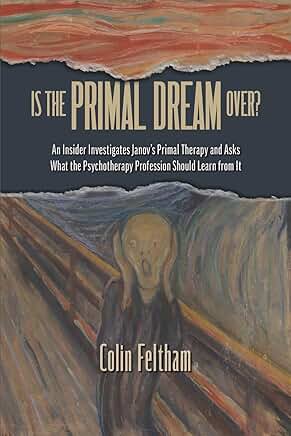
By Colin Feltham
CURE OR JUST ANOTHER FAD?
Review by Gunnel Minett
The subtitle to this book is: “An insider investigates Janov’s Primal Therapy and asks what the psychotherapy profession should learn from it.” The book certainly asks this question and arrives at the conclusion that Janov was probably a flawed person selling a flawed form of psychotherapy. A therapy that may have done as much harm as good. It also becomes clear that people who signed up for it did so at a high cost, in terms of both their financial and their emotional investment. The author can make these claims with authority. He was one of the many who signed up for this therapy in Los Angeles in the 1970.
Even though the book deals mainly with the experience of Primal Therapy, it also offers general insights into other areas of psychotherapy. In particular it points out that during the heyday of Primal Therapy in the 1970s, a number of similar psychotherapies also emerged. What they had in common was that they all offered ‘a cure’ and that they claimed maximum effectiveness, often in the sense of providing the only ‘real cure’ available. For many of their clients, this development involved rejecting all scrutiny, based on the general assumption that these radical new therapies did not need to offer a thorough explanation as to how and why they worked.
As a client of Janov’s Primal therapy, Feltham offers a thorough analysis of the problems and weaknesses of these types of ‘miracle cures’. He looks at group therapy, followup support, theoretical explanations and therapist qualifications, both real and dubious. He also looks at Janov’s private life and background to find explanations as to how he worked and how his system of therapy was constructed as well as real testimonies from clients versus the claims made in Janov’s books.
Towards the end of the book, Feltham raises more philosophical questions regarding the whole concept of finding a ‘cure’ for what we perceive as psychological pathology or more general feelings of depression and despair. He writes: “Human susceptibility to fads, cults, new religious movements, and waves of psychological and political hope and upheaval will always be with us.” [p154]
They also tend to come in waves. In the seventies, following the heyday of the ‘counter culture’ movement, with its introduction of psychedelic drugs, intensive and intrusive mind-altering therapies such as Primal Therapy became fashionable. As the author points out, many of them would now be seen as too brutal. Feltham also concludes that the money he paid for the Primal Therapy could have been spent in better ways since it didn’t really change him in the positive ways promised by Janov.
Another interesting interesting aspect of the book is the exploration as to why people are drawn to charlatans, and sometimes stay loyal to them even when they realise that their leader/teacher is not delivering. Even in the contemporary world there are numerous examples of both of therapists and other types of influencers, such as politicians, who are able to generate strong support, despite massive criticism that they are not keeping their promises.
However, the author ends the book by stating: “What we should not conclude, however, is that all psychotherapy founders are snake oil salesmen, and all therapists are charlatans. Many are sincere and helpful. Those with odd personalities, greedy motives, fanatical attachments to their own theories, and who are rigidly wedded to certain procedures are the ones to worry about. Simple human responsiveness in our sometimes painful world is key, I believe.” [p162]
IPBooks, Queens, NY, USA, 2025, 344 pp Paperback, ISBN: 978-1-956864-93-9
 breathwork-science