
by Elizabeth Burns Dyer, psyche.co
The overwhelm of grief and parenthood showed me what psychoanalysis assumes – we need to be held to feel safe in solitude
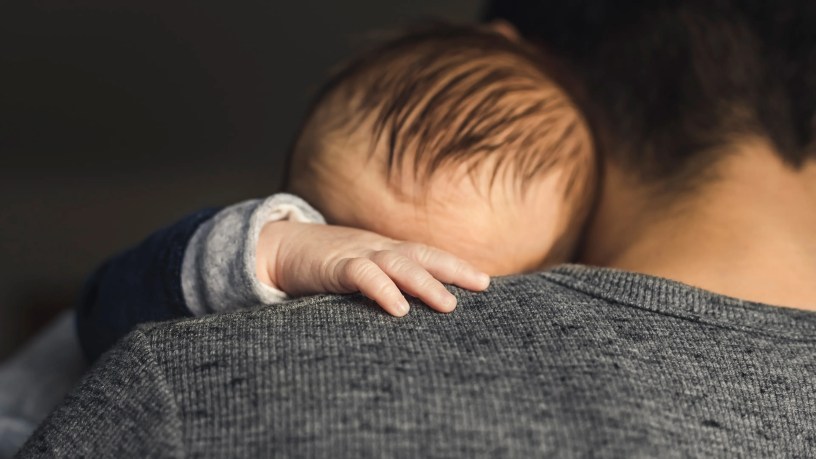
After my son was born, I developed the habit of waking him to make sure he was asleep. He would finally drift off with his mouth slightly open, making soft, milky lip-smacking sounds, his breathing deep and even. He was utterly at rest, a small body practising trust. And then I would appear, bent at the waist and hovering over the bassinet like a poorly trained medic in a disaster drill. I leaned in to listen for breathing that was plainly happening and checked for warmth that was unmistakable. Sometimes I placed a hand on his chest, lightly, just enough to confirm that life was still there but ideally not enough to wake him. Most of the time he startled awake all the same, and I was left holding the evidence.
His sleep was the one condition under which I sometimes began to feel safe alone with myself, but I could not yet trust that possibility. So I kept interrupting it, like a person checking whether a candle is still lit by blowing on it.
We have language for experiences like mine. We name anxiety, depression, or postpartum adjustment disorder. But none of these quite touch on what felt most disorienting for me, which was not fear or numbness, but the fact that I’d lost the ability to rest in solitude.
What I could not see at the time was how much else I was already carrying. My father had died, and my mother’s mind was rapidly unspooling. As an only child, I had become the primary point of orientation for her care while also parenting an older toddler at home. At the same time, the wider structures that had once distributed responsibility were thinning everywhere. Wildfires turned ordinary days into emergency drills. A pandemic collapsed work, parenting, and grief into the same unbroken hours. For me, the work of holding did not begin with the baby. It merely intensified there.
But my field of vision had narrowed enough that no such context was visible. If solitude no longer restored me, I assumed I needed to do it better, through better sleep, mindfulness and discipline. It took time to understand that this was not a personal failure, but a shift in the labour solitude was being asked to absorb.
Psychoanalysis offers a way to think about this shift, even though it often tells the story much earlier in life. The British analyst Donald Winnicott argued that the ability to be alone is not a personality trait but something that develops out of experience. His best-known line about solitude is deliberately paradoxical: ‘The basis of the capacity to be alone is the experience of being alone in the presence of someone.’ He meant that we learn how to rest, play and think on our own only after we have known what it feels like to be reliably accompanied, to have someone nearby who is not intrusive but also not absent. Over time, that sense of being held can be carried inside, making solitude feel safe rather than exposed.
But Winnicott did not fully theorise the conditions that make such presence possible. Feminist scholars like Nancy Chodorow have long argued that caregiving itself depends on how care is socially organised and shared. Attentive, non-anxious presence requires stability, time and collective support. In that sense, the capacity to be alone rests on a series of nested forms of holding, each one dependent on the next.
In his later writing, Winnicott focused on what he called the facilitating environment: the ordinary supports that allow a person to keep functioning and feel real over time. Development, he argues, requires ‘good-enough environmental provision’ and ‘progressive adjustments adaptive to individual needs’, not only in infancy but across the life span. From this perspective, psychological health depends not only on early experience, but on whether present circumstances still provide enough steadiness to make solitude feel safe.
Fortunately for our baby, I was not the only parent at the helm. Unfortunately for me, I did not seem able to rest in my partner’s support. When the baby slept, my husband slept too, dropping into unconsciousness as if this were simply how the world worked. His calm was not naive. It was infrastructural. Even with loving partnership and shared labour, my mind never went off duty.
In other words, the solitude I was struggling inside was not the absence of people, but the collapse of trust in anything outside myself. It felt as if my emergency call list had disappeared overnight, and I had been left to hold everything together alone. There was little room left for thought.
This is where Wilfred Bion, another English psychoanalytic thinker, helps clarify what was happening to me – when experience arrives faster than the mind can make sense of it. In Bion’s account, thinking is not a given but an achievement that depends on having had enough support for feelings to be transformed into thoughts. When pressure cannot be processed, when there is too much coming in and nowhere to put it, experience does not become reflection at all. Instead, it is discharged into action and vigilance.
From this perspective, the problem is not whether someone is physically alone, but whether their mind is free to wander or still on duty. When vigilance replaces containment, time alone does not become rest. It becomes another shift.
This is not unique to new parents. When people lose work, healthcare, legal security or housing, attention narrows and solitude fills with quiet contingency planning. Time alone becomes another place where survival is privately managed.
Looking back, I can see how completely my life had reorganised itself around constant doing: holiday cards, shopping lists, parenting books. I memorised the language of care and relied on parenting scripts that required little thought and no emotional presence. It’s OK to feel upset; it’s not OK to hit. Do you want a hug or some space right now? I was not responding in the moment; I was containing both of us. The scripts kept my child steady and kept me from falling apart, as I tried to keep the candle lit.
At the time, I thought grief had educated me, that it had made me more careful and responsible, more adult in ritual and form. I imagined that I had become the superstructure that had disappeared around us. In Winnicott’s terms, what looked like maturity was a very competent false self, a way of managing life when there is not enough support for spontaneity or play. But this was not maturity. It was pressure that could not become thought, hardening instead into vigilance. What might have become grief condensed into a heavy season that I mistook for adulthood.
What actually began to change the texture of my thinking and my time alone was not insight at all, but a shift in my material and relational situation. Under the weight of exhaustion, I leaned more fully into my marriage, letting my partner carry things I had been holding as mine alone. I brought in paid help, far more than should be necessary to survive parenting and care, and I remain uneasy about how unevenly that kind of relief is distributed and how closely it tracks privilege rather than need. None of this resolved the losses I was living with, but it redistributed the work of holding and gave responsibility somewhere else to land. Only then did my mind have any room to do something other than monitor.
It was only then that mourning, in Melanie Klein’s sense, could begin to do its work. Klein, a psychoanalyst whose ideas shaped much of 20th-century thinking about emotional life (including the work of Bion and Winnicott), understood mourning not as letting go, but as learning to hold good and bad aspects of the same relationship together without splitting them apart. Mourning reorganises the inner world so that what is lost can be carried internally without idealisation or denial. Contact becomes possible again, not purified, but real. She called the capacity that makes this possible the ‘depressive position’, by which she meant not sadness but the ability to tolerate ambivalence.
When that capacity is overwhelmed, the mind simplifies in self-defence. Things become either safe or unsafe, alive or dead. This was exactly why my postpartum vigilance felt like a refusal of gradients. My task, as I experienced it, was to keep the baby on the correct side of every divide. The cost of that demand was enormous, because rest requires tolerable uncertainty. Sleep is a surrender, and surrender is unavailable when the self has been appointed the sole guardrail.
When mourning begins to work, those divides loosen and a more complex inner world returns. The baby can be alive and vulnerable. I can be loving and inadequate. The world can be damaged and still liveable. No sirens sound. The floor holds. The solitude that emerges here has weight. It is not the solitude of disappearance, but of presence without supervision.
Over time, support began to take up residence inside me again. I stopped bracing so hard against catastrophe. But it was only once the work of holding was no longer mine alone that grief could finally move through me. There was sadness, and a real weight to relationships, because this was a more exposed way to love. And yet, there was also room for silliness and not knowing, for letting things wobble without rushing to steady them.
I think about this when I watch my seven-year-old son in a school play. He had been cast, against type, as a butterfly, complete with silk wings and, inexplicably, a straw hat. I was tired and he was mortified, but we both showed up.
At some point during the performance, he found me in the audience and our eyes met. What passed between us felt less like reassurance than permission: not to flee, not to correct the moment into something respectable, but to stay with the feeling and see what might happen.
Then he went to work. He slowed the choreography. He added a few precise flourishes, a waggle of his eyebrows, a thumbs-up on the downbeat. Was that a butt shimmy? He let the awkwardness of the costume become part of the act rather than something to overcome. What had been uncomfortable turned funny. The audience laughed, not politely or nervously, but with relief and recognition. Yes, this was absurd. And yes, it was also incredible.
This, I think, is what Winnicott meant. Not that solitude is virtuous or independence a moral achievement, but that being reliably held by someone else makes it possible to relax into oneself. It creates enough internal safety to play, to improvise, to stay present without constant supervision. Over time, that experience of being accompanied continues inwardly, becoming a way of being with oneself.
We do not learn this once and for all in childhood. We keep relearning it, often through loss and strain. Solitude, understood this way, is not the opposite of attachment. It is one of the quieter ways attachment keeps going.
About the author; Elizabeth Burns Dyer is a writer, psychotherapist, and doctoral candidate in clinical psychology with a PhD in history. Her writing explores care, dependency, and the ways private life absorbs the work of failing institutions,
Keywords; attachment, parenting
 breathwork-science