
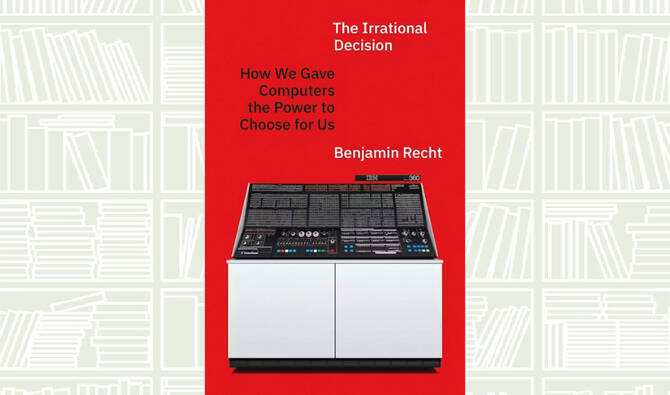
By Benjamin Recht
DOES AI NEED PSYCHOTHERAPY?
Review by Gunnel Minett
AI has become a major topic in so many areas of life today. Books and the media are full of speculations as to how AI may take over the world. Many people are convinced that it won’t be long until we have computers with a consciousness similar to that of a human being. Some even speculate that computers will take over and that AI will work out ways of controlling humans rather than the other way around.
In this book Benjamin Recht wants us to take a step back and reflect on how AI was developed and why. It started in the 1940’s. The world had just been through its worst war and scientists, particularly mathematicians, were eager to come up with technology that could help humans to act as ideal rational agents in the face of uncertainty. A process which became known as optimisation. One of the results of this endeavour was to coin a peculiar mathematical definition of rationality. This involved posing every decision as a question of statistical risk. Much of this development was devoted to helping the defence sector to plan for new wars. The quantitative standard they developed came to define our understanding of rationality. This evolved out of a study of optimisation, game theory, statistical testing, and what later became known as machine learning.
Recht describes how difficult it was, in some situations, to find the optimal solution. One such area concerned the search for the optimal diet, based on price and nutritional value. The problem was that the ‘optimal’ diet was so awful that most people would struggle to eat it. But despite such setbacks, the development of similar tools continued, very much stimulated by the fact that the performance of data processing was constantly and rapidly improving, enabling computers to tackle more and more tasks better and faster.
A major challenge was designing the underlying computer programming. If too many variables were included, the results become unmanageable for linear processing. One way to resolve this problem was game theory. However, early on, even in a strictly law- based game like chess, the numbers of legitimate moves was too many to handle, but as the power and capacity of computers rapidly expanded, this became less of a problem. On the other hand, as Recht argues, life is not governed by rules as is the game of chess.
This fast and furious development of computers has produced excellent results in many areas, but, Recht points out, even if this has been a boon for research, manufacturing, medicine, planning, etc.., we have to be very careful when it comes to applying computer calculations to human behaviour. Computers can calculate, but not in the same way as humans. One area where this difference is apparent relates to self-driving cars. It’s no problem to get computers to do all the ‘mechanical’ driving. The real problem, however, occurs when the driver has to make decisions that involving compassion or morality; for example, should you allow the car to (i.e. not optimising the output) to avoid hitting a pedestrian. When computers and software get involved in such issues, Recht sets out a clear warning: “The power of human choice is only amplified by working together, whether it be through organising to change your work experience or how your government rules. It’s not easy. It’s not straightforward. But the best way to push back against machine rationality is to choose to gather together our collective humanity on the small scale.” [p.236]
We have become so used to computers making decisions for us that we have started to think that we are like computers. For example, psychotherapy is already being carried out by computers. Recht describes the developmental history of computers: “We’ve explored how its four pillars—optimisation, game theory, the randomised clinical trial, and machine learning—arose through a vision of the future in which computers become the “ideal rational agent, enriching human society by computing optimal decisions in the face of uncertainty.” [p.210] But then he warns that human life is not linear, not bound by laws and regulations like games.
Psychotherapists will know that it is not simple and rule-bound to determine what kind of help a person with psychological problems need. So psychotherapist need to make their voices heard. It’s clear that tech companies are not run by experts on psychology. Far from it. Their goal is to optimise monetary outcomes even if it is at the expense of their consumers inner wellbeing. Generations of young people are providing clear evidence of this. So leaving psychotherapy and general psychological wellbeing to the tech sector is not a good idea. There is far too much at stake.
The maxim should be; computers are a good servant but a bad master! The author finishes with the following advice: “I have argued that we can’t compute our way to utopia. But we can be honest about what we are doing as computational scientists, engineers, and policymakers. We can be frank about how our work impacts people.” [p.235] So, rather than letting computers take over psychotherapy, perhaps we should come up with ways to subject AI to psychotherapy!
Princeton University Press, 2026, ISBN-13 : 978-0691272443

