
What ancient art tells us about modern psychedelic medicine
by William McCarthy, medical researcher. Psyche.co
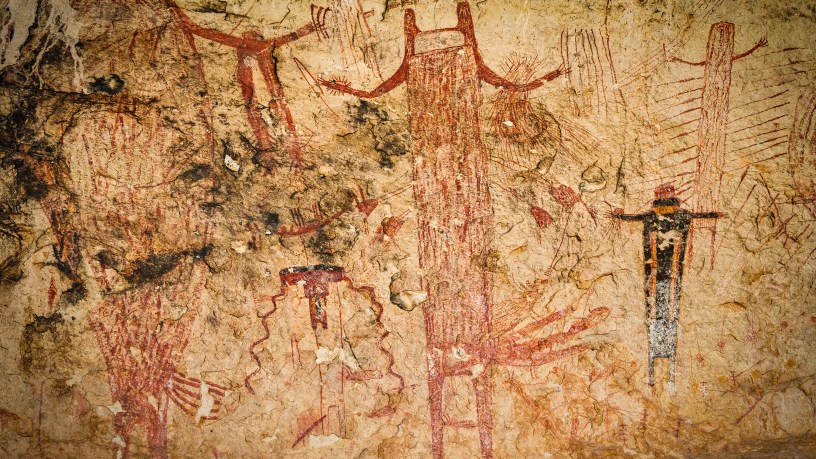
The use of psychedelic substances stretches back far beyond the advent of modern medicine. In the remote canyons of West Texas, ancient rock murals hold what might be the oldest visual evidence of psychedelic rituals in North America. Peyote specimens – fibres from mescaline-containing cacti, dating to roughly 4,000 BCE – have been discovered among the caves there, and correspond to the archeological era during which this regional mural tradition emerged. The murals, vibrant pictographs that stretch along the stone walls of the Lower Pecos River, portray antlered shamans near impaled peyote cacti, a spotted catfish goddess hovering near a headless lunar goddess, and a 10-foot-long panther with reaching paws – symbols suggesting a profound connection between ecology, medicine and spirituality.
According to conversations between the archaeologist Carolyn E Boyd and elders of the Wixárika (an Indigenous group also known as the Huichol), the rituals and imagery in these murals resemble those of present-day Wixárika ceremonies, notably with regard to a deer god depicted in the paintings. In one particular ceremony, which involves a pilgrimage and spans vast landscapes, peyote is sought like a deer, shot with arrows, and consumed in a healing ritual. Wixárika elders describe this ritual as a hunt and a retracing of ancestral paths – a journey to sacred sites, guided by the lessons of peyote and intended to restore both physical and spiritual wellbeing. In several of the Lower Pecos caves, symbols preserved in the rock suggest ancient versions of these rituals.
In 2021, I started kayaking through this landscape with my art professor Mark Monroe and close friends to reach many of the mural sites, navigating steep muddy banks and the rocky walls of the canyon. The beauty of these paintings, often looming overhead on arched walls, continues to inspire my imagination.
As a researcher and medical student studying the effects of psychedelic compounds (psilocybin and its psychedelic metabolite, psilocin), I often think of the Lower Pecos rock art. Analysing the morphology of neurons before and after psychedelic drug exposure, I wonder about how these drugs have shaped our human cultures. I wonder, too, why scientists still have so little clarity about the best ways to use them for healing purposes and about why they might be helpful, even as the rituals and imagery of the distant past seem so rich. Have we lost touch with something fundamental about healing?
Psychedelics are moving from the margins of science to mainstream psychiatric medicine. Clinical trials of psilocybin (found in ‘magic mushrooms’), LSD, DMT (found in ayahuasca), and mescaline (found in peyote cacti) are producing promising results in the treatment of a wide variety of psychiatric disorders, from alcohol use disorder to obsessive-compulsive disorder. Most notable, perhaps, is the rising evidence that psilocybin is an effective treatment for depression, with some trials finding that it offers greater symptom reduction and fewer side-effects compared with current pharmaceutical treatments. Yet amid this ‘psychedelic renaissance’, there’s a risk of forgetting the deeper histories of these substances.
In much of modern research, psychedelic use is compartmentalised into molecules and protocols: chemical agents acting on neurotransmitter receptors, their effects quantified through questionnaires or brain scans. This framing, while scientifically rigorous, may strip away a key element of these medicines’ meaning. Pharmaceutical companies are beginning to frame psychedelics as ‘novel therapeutics’ rather than as sacred medicines with complex cultural legacies and the potential for lasting changes in perspective.
In my previous work at the MD Anderson Cancer Center at the University of Texas, I’ve seen how the benefits of psychedelics are being explored at the cutting edge. As we studied the effects of psilocybin on neurons, with a focus on how this can help patients with cancer-related pain, a parallel clinical trial is exploring psychotherapeutic benefits for these same patients. I’ve listened to patients describe their personal experiences with these substances, including a sense of the breaking down of the boundaries between the self and the world. Recent research in this field confirms that psilocybin works differently from conventional antidepressants. Brain imaging studies show increased global integration after psilocybin therapy: different regions of the brain begin to communicate with each other more, likely loosening rigid patterns of rumination and fear that are associated with the brain’s default mode network. This may help explain why patients often describe not only relief from depressive symptoms, but a sense of interconnectedness with other people and the world at large.
There seems to be growing recognition, including at my institution, that healing involves more than targeting pathology. It is evident in integrative medicine programmes that attend to meaning, ritual and community in recovery, and in the meditation, writing and yoga group classes such programmes offer to help address the psychosocial elements of healing. This resonates with what the ancient murals suggest: that healing, even when it involves a powerful substance, is embedded in story and ceremony.
Emerging research, including a study published last year, continues to deepen the current understanding of these paintings. Using radiocarbon dating, Boyd and her team demonstrated that the Pecos River-style tradition persisted for more than 4,000 years, spanning 175 generations. The iconographic vocabulary remained remarkably consistent.
Boyd’s team asked the question: why return to the same sites to paint for thousands of years? Their answer: the concentrated sacred power of the Lower Pecos Canyonlands landscape made it essential for ritual and the ancestral transmission of knowledge across generations. The region’s deep canyons, caves, springs and winding rivers were likely understood by the local Indigenous communities as places filled with potency, possibly as portals to ancestral knowledge.
Modern psychedelic research has begun to echo some of this wisdom, if somewhat by accident. Studies consistently find that psychedelic experiences can include powerful feelings of connection to nature and recognition of ecological interdependence, which have been described as ‘nature-relatedness’. Rather than treating these as side-effects to be noted and set aside, we might consider them as therapeutic mechanisms and markers for success. These medicines seem able to help restore a sense of belonging that illness has severed for many patients, who are often uprooted from their usual social support and routines, and face an increased risk of loneliness or isolation.
Psychedelics may be a lens through which we understand human health as being fundamentally tied to the natural world. Across multiple countries, spending time in nature has been shown to be associated with lower rates of depressive symptoms. In turn, psychological and physical connection with nature has been found to increase pro-environmental and conservation behaviours. In an article in The Lancet Planetary Health, Indigenous scholars and practitioners articulated the importance of a sense of interconnectedness with the planet, which they describe as ‘a transformational relational process of understanding that can stimulate psychological integration and a sense of responsibility to the larger world’.
Perhaps this is one of the most instructive lessons the murals offer modern medicine: the canyons, springs and rock shelters were part of the medicine, inseparable from the plants consumed and the experiences they induced. Healing was not something that happened to an individual in isolation, but something that happened in relationship: to place, to community, to the living world. The peyote rituals were possibly means by which people remembered their place in a larger story.
Standing in those Texas canyons, looking up at shamans painted with ochre and charcoal, I have felt the weight of deep time. These images have survived drought and flood, colonisation and development pressures. Today they face new threats. Climate change intensifies flash flooding, conservation funding is precarious, and vandals continue to deface ancient paintings in the American Southwest. While kayaking past some paintings, I saw spray-painted initials scrawled over ancient coyote depictions, and sheep whose huddled crowds further erode the painted record. The latest threat is a new US-Mexico border wall plan. We risk losing ancient art as well as ancient wisdom about healing, and some are working against the clock to preserve this library of stories.
The choice facing modern psychedelic medicine mirrors the choices humans have to make about these mural sites: honouring cultural context or erasing it. If scientists and clinicians end up focusing too much on isolated molecular mechanisms without giving due recognition to natural and historical settings, we may miss the deeper healing of connection that these medicines offer.
When a cancer survivor shared his powerful journey through psychedelic-assisted psychotherapy with my research group, I remember hearing themes of radical reconnection – to self, to others, to meaning in the face of death, to the world that he thought was lost upon receiving his diagnosis. What experiences like this suggest, and what the ancient artists seem to have known, is that a critical part of healing is remembering our place in the larger web of life. The antlered shamans painted on those canyon walls are still teaching us, if we’re willing to listen. The question is whether modern medicine and public policymakers can summon the humility to learn from what has been preserved in stone.
About the author; William McCarthy is a medical student, researcher, writer and co-founder of the non-profit Health In Your Hands Diagnostics. His research includes neonatology, cancer neuroscience, environmental health, and global health diagnostics innovation. He is a student at McGovern Medical School in Houston, Texas.
Keywords; psychedelic drugs, psychotherapy

