
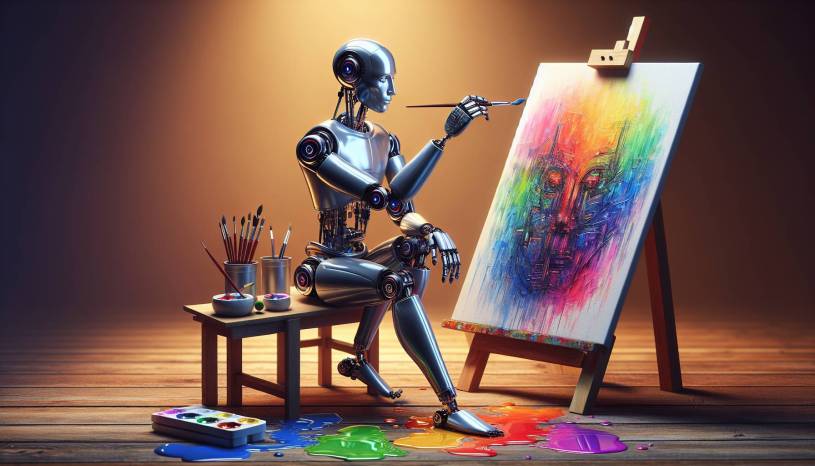
Source: The Hebrew University of Jerusalem
Generative artificial intelligence algorithms can now assemble gallery-worthy oil paintings, orchestrate complex symphonic movements, write evocative poetry, and draft architectural blueprints in a matter of seconds. Across many metrics, these synthetic creations rival works that historically demanded decades of disciplined human apprenticeship.
As machines demonstrate the capacity to produce virtually any aesthetic artifact on demand, cognitive scientists, philosophers, and artists face a foundational dilemma: if algorithmic networks can generate sophisticated art instantaneously, what is the ultimate value of human creativity?
In a paper published in the journal AI & Society, Amit R. Zoran, PhD, an associate professor at the Rachel and Selim Benin School of Computer Science and Engineering at The Hebrew University of Jerusalem, offers a conceptual framework to address this question.
Rather than engaging in circular debates over whether synthetic media meets the technical definition of “art,” Zoran argues that human creative cognition derives its significance not merely from the finished product, but from the neurocognitive and experiential transformations that mold artists, audiences, and human culture across time.
The “Decoupling Thesis”
Historically, mastering an art form required years of intense deliberate practice, sensorimotor refinement, emotional maturation, and perceptual recalibration. A painter did not merely train their hand to mix pigments; they fundamentally restructured their visual processing systems and internal models of the physical world. A cellist did not simply memorize finger positions; they integrated acoustic feedback, fine motor control, and emotional regulation into a unified mode of expression.
Zoran formalizes how generative AI disrupts this historical unity through what he terms the “decoupling thesis.” The framework posits that AI tools now allow individuals to manufacture highly sophisticated aesthetic artifacts without undergoing the arduous cognitive and emotional maturation previously required to realize them.
“For centuries, creating art meant going through a process of learning, experimenting, and changing as a person,” explains Zoran. “Today, AI allows us to produce sophisticated works without necessarily undergoing that journey. But this doesn’t mean human creativity has lost its value. It means we need to rethink where that value lies. The real potential of AI is not simply to help us produce more images, music, or designs, but to open new possibilities for how we experience, understand, and engage with the world around us.”
By detaching technical output from personal development, AI strips away the traditional gatekeeping of craft. However, Zoran emphasizes that automated generation should not be mistaken for genuine creative cognition. When output becomes frictionless, the scarcity and ultimate value of human creativity pivot from technical execution to interpretive depth, philosophical inquiry, and relational engagement.
Reimagining Technology as an Experiential Catalyst
Rather than displacing human creative drive, algorithmic tools can be redirected toward deepening multisensory exploration and collaborative synthesis.
To illustrate this potential, the paper examines hybrid creative projects where computational systems serve not to flood digital feeds with synthetic imagery, but to enhance bodily and environmental awareness. In one featured installation, a living tree becomes the focal nexus of a shared, participatory encounter. The piece integrates olfactory stimuli, taste, environmental field recordings, adaptive AI-generated music, and spatial visual projections.
Instead of trapping the human participant inside an algorithmic screen, technology acts as a sensory amplifier, prompting visitors to engage with the natural environment and living systems in ways previously inaccessible to standard perception.
Metrics for the Next Generation of Creative Tools
Zoran’s analysis presents direct challenges for computational design, software evaluation, and creative arts education:
- Shifting Engineering Benchmarks: Current generative models are optimized and marketed according to latency, computational efficiency, visual photorealism, and benchmark fidelity. Zoran argues that human-centric systems should instead be measured by whether they provoke intellectual curiosity, inspire novel cognitive associations, and foster personal introspection.
- Reallocating Cognitive Bandwidth: Instead of viewing AI as an automated assembly line, artists can leverage time saved on routine execution to engage in radical conceptual experimentation and deeper cultural critique.
- Educational Paradigms: Cultural institutions and universities must move away from evaluating students solely on finished aesthetic deliverables, placing greater pedagogical emphasis on the introspective, developmental journey of the creative process itself.
Ultimately, the democratization and automation of aesthetic production may deliver an unexpected cognitive benefit. By relieving humanity of the necessity to treat technical execution as the sole arbiter of artistic worth, artificial intelligence provides a rare opportunity to rediscover the true core of creativity: an ongoing transformation of the human mind and its perception of the world.
Keywords; AI, creativity

