
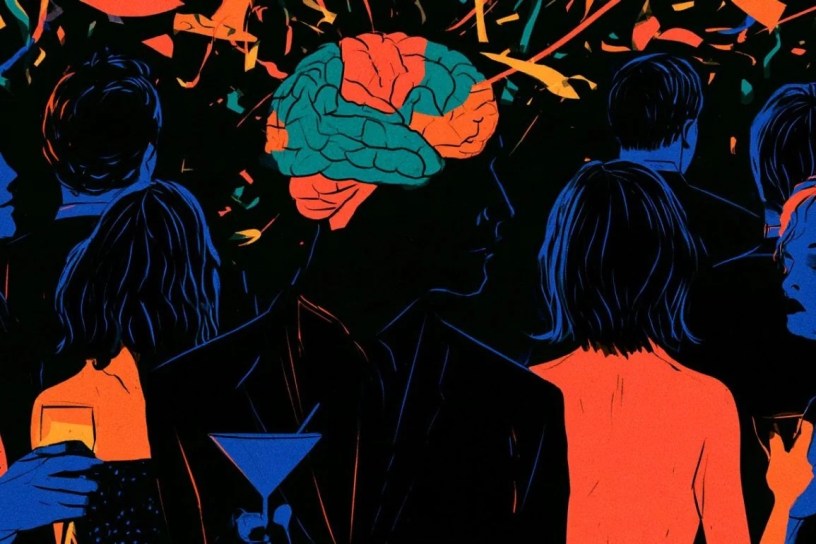
Source: Society for Neuroscience (SfN) / University of Helsinki
Navigating a crowded room where multiple conversations overlap simultaneously, famously known in cognitive psychology and audiology as the “cocktail party problem”, represents one of the human auditory system’s most complex computational feats. To follow a chosen speaker amid the auditory din, the brain must selectively filter acoustic interference, parse phonemes, track speech rhythms, and extract conceptual meaning in real time.
While classical psychoacoustic research focused on physical properties like voice pitch, spatial location, and loudness, how semantic and emotional dimensions drive selective listening in naturalistic dialogue has remained less understood.
Now, an electrophysiological investigation led by Pyry Heikkinen and colleagues at the University of Helsinki reveals that the emotional charge of speech and the narrative coherence of conversation serve as primary neural tuning knobs.
Publishing in The Journal of Neuroscience (JNeurosci), the research team recorded neural activity across 32 adult participants tasked with attending to specific dialogues while competing voices played concurrently in the background.
Tracking Speech Through an Emotional Lens
The researchers compared brain responses as listeners followed two distinct conversational scenarios: one exchanging emotionally meaningful, socially relevant narratives featuring unpleasant, high-arousal themes, and another exchanging neutral, everyday statements.
Neural decoding models revealed that high-arousal, emotionally significant speech dramatically boosted neural entrainment—the fidelity with which cortical oscillations synchronize to the acoustic rhythm and amplitude envelope of spoken words.
“We could predict the rhythm of speech a participant was hearing more accurately from their brain activity alone when the conversation contained emotional meaning,” explained Heikkinen.
The findings indicate that emotional salience acts as an automatic sensory filter, signaling subcortical and cortical attention networks to allocate greater processing bandwidth to socially and biologically critical vocal cues.
The Cognitive Toll of Conversational Topic Jumps
Beyond measuring emotional intensity, the investigators manipulated the structure and flow of the dialogue. In one condition, statements followed a logical, cohesive narrative thread; in another, comments jumped abruptly and unpredictably between unrelated subjects.
When dialogues lacked narrative continuity, the brain was forced to mobilize substantially more neural resources over extended temporal windows to decipher the emotional messages. Without a predictable contextual scaffold, the auditory cortex and associated language hubs could not rely on top-down predictive coding to anticipate incoming words.
Conversely, when comments were sequentially linked, listeners leveraged established conversational context to anticipate upcoming phrases, streamlining neural processing and reducing cognitive overhead.
“These findings suggest that the brain handles emotional speech differently depending on how the conversation flows,” said Heikkinen. “Sudden topic changes may require more work to process, while connected comments help the brain use the previously established context to predict what comes next and thus process speech more efficiently.”
Social Engagement and Real-Time Dialogue
Detailed temporal analyses further pinpointed the sequential activation of specific cortical networks as they prioritized and decoded emotional speech over competing background chatter.
The authors note that this efficiency boost in coherent dialogue likely underpins successful real-world social interaction. When conversational flow allows the brain to rapidly predict a speaker’s words, listeners can allocate spare cognitive bandwidth to interpret subtle vocal inflections, gauge social intent, and formulate timely, empathetic responses.
By defining how affective meaning and conversational coherence interact during selective listening, the study provides fresh insights into social communicative deficits, offering a neural framework for why individuals with sensory processing differences, social anxiety, or hearing impairments find noisy, fragmented group settings particularly exhausting to navigate.
Keywords; neurotech, schizophrenia

