
By Andrea Malesevic
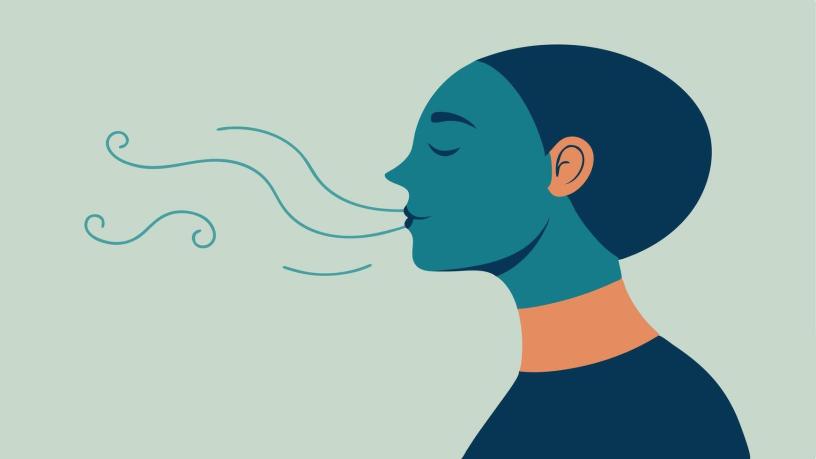
Frantz Fanon said about the anticolonial struggle: “We revolt simply because, for many reasons, we can no longer breathe”. He understood the role of breathing as not just an individual body impulse but a collective political concern. His words echo in the Black Lives Matter protests and in the dying words of Eric Garner and George Floyd: “I can’t breathe”. Being deprived of the conditions for living ultimately drives people to overthrow the society that suffocates them, Fanon argued, giving the fight for breath a revolutionary potential. The antiracist movements for breath can be tied to health care protests and movements against climate change: its struggles about life for life, for a breathable future. Respiration operates as a metaphor as well as a concrete biological reality; it also plays an important role in intersubjective communication. In the clinical room our patients talk to us not just with speech but through their bodies; gasping for air in the panic attack or shut down respiratory communication when dissociate. Teaching out breathing exercises is rarely enough to help someone breathe. It’s more profound and relational: you must be truly seen in your subjectivity, in your wound as well as in your resistance. A case example from Caroline Eliacheffs infant analysis lights color on this statement. Jamieson Webster and Patricia Gherovaici also argue that breathing has been neglected in psychoanalysis and in the unconscious libidinal economy. They speak of a respiratory drive whose object is more than air, taking in sexuality and death. In this paper respiration is explored through the lens of different psychoanalytical and political theories. The purpose is to exam if the consideration of breath can help us in the quests to see what is being repressed, denied and dissociated in both the individual and social consciousness, making room for a revolutionary breath.
On July 17, 2014, Eric Garner is strangled by police officer Daniel Pantaleo after being suspected of selling cigarettes on the street without permission. Garner utters the words “I can’t breathe” eleven times before he dies. On May 5, 2020, George Floyd is choked to death by police officer Derek Chauvin. Chauvin presses his knee against Floyd’s neck and back and the pressure makes it difficult for him to breathe. For eight minutes, Floyd lies still with handcuffs on and begs for his life: “I can’t breathe”. He dies later in the hospital.
These murders are just the tip of an iceberg of police brutality and structural racism that has led to mass protests, riots and demonstrations under the slogan Black Lives Matter. The words echo in the protests: I can’t breathe. The words become a collective testimony about black people’s experiences of racism and a demand for change. We can’t breathe. We need to live in a society where we can breathe.
Breathing is a political matter. That was the opinion of the philosopher and psychiatrist Frantz Fanon, who observed the anti-colonial struggle in Algeria in the 1950s in his books Wretched of the earth and Black Skin – White Masks. He writes: “We revolt, simply because, for many reasons, we can no longer breathe”. In his texts, respiration has a central place as it is the symbol of our humanity, essential for the lived life. In his texts, he often uses words such as “suffocated”, “strangled” and “captured” to describe the colonized’s experiences of the ongoing violence. In a racist society, the black person is deprived of his human dignity, his right to breathe and is considered a non-living object. This leads to a profound alienation.
Fanon’s point of departure is in Hegel’s philosophy and that our selves come into being in relation. It is through the Other and her reflective gaze on us that we come into existence. Recognition is our most basic desire. Without recognition, we can’t live like human subjects we can’t breathe. If the Other looks away, my reality becomes unconfirmed and I have only an averted look: a kind of non-existence, “a zone of non-being, an extraordinarily sterile and barren area, an extremely naked slope” writes Fanon. He describes that this is what happens to the black man in a society that values whiteness culturally and materially. Fanon writes that the black man does not really exist, as little as the white man exists, but race is such a powerful fantasy that is created via culture and economic institutions that generates material impact on our bodily freedom. “He only asks for one thing. That the idiots and exploiters should give him the chance to live as a human being.”.
Being deprived of the conditions for living ultimately drives people to overthrow the society that suffocates them, Fanon argued, giving breathing a revolutionary potential. In the struggle to breathe, to be recognized as human, the lungs receive new oxygen and prepare the way for a different kind of life. A new life form, a new subjectivity, a revolutionary subjectivity.
Psychoanalyst Kirkland C. Vaughans has researched the childhood of black boys and how their subjectivity is formed based on aspects such as generational trauma, class and racism. In his research, he has seen how black boys are portrayed as “risk groups” and called men when they are 12 years old. In one study, the Vaughans saw that black boys are considered, on average, four years older than their actual age, unlike white boys who are estimated to be their actual age. Vaughans discusses the difference between being considered an adult and belonging to a “risk group” and being considered as a child – vulnerable and in need of guidance. These two different approaches are associated with different kinds of affective responses. The vulnerable child arouses feelings of compassion and responsibility from outside, while the “adult in risk” arouses fear, loathe and demanding of personal responsibility and obedience. Vaughans believes that this collective image is internalized by many and creates a distorted image and a dysregulated bodily state. He writes: During sessions, I observe the boys’ desperation reflected often in their dazed facial expression when I inquire, “Do you know what to do when stopped or challenged by a police officer?” Some jokingly reply, “Prepare to die”, while others look like a stunned deer caught in the headlights.
Vaughan’s describes how his young male patients struggle with feelings of stress and alienation because of this internalized image, always feeling under threat and as a threat. He says that to protect themselves against these painful experiences, they use dissociation as a defense. Dissociation is a psychophysiological response to traumatic stress that involves a change in consciousness, to screen off from reality and to lose contact with one’s own body and needs in various ways. Normal functions such as hunger, pain experiences and breathing become dysregulated. The body is as if in a constant state of war.
Vaughn argues that unresolved generational trauma among African-Americans, is a function of an unmourned original collective historical trauma, as well as the persistent and oppressive social assault targeting the black community at later periods in American history. Vaughn states “Therefore, the redemption blacks seek cannot be offered through individual psychotherapy or psychoanalysis alone but must be obtained through a communal effort of liberating our colonized minds of cultural introjects.”
The universal right to breathe. That is the title of an article by philosopher Achille Mbembe that further develops Fanon’s ideas. The article was written as a commentary on the coronavirus and climate change, and the racial disparity in who is most affected by these crises. After the execution of Floyd, the article took on another dimension and made clear how central and multifaceted the fight for air is. The demand to breathe connects the anti- racist struggles with the fight for the climate and health care, says Mbembe. These are social struggles for life, for life. Mbembe writes:
Before this virus, humanity was already threatened with suffocation. If war there must be, it cannot so much be against a specific virus as against everything that condemns the majority of humankind to a premature cessation of breathing, everything that fundamentally attacks the respiratory tract, everything that, in the long reign of capitalism, has constrained entire segments of the world population, entire races, to a difficult, panting breath and life of oppression.
Mbembe discusses the concept of necropolitics as an extension of Michel Foucault’s theories on biopolitics: how power in modern society primarily operates through a regime of death, the power to be able to kill or let to die. Necropolitics is partly about who has the right to kill, such as the police and the military based on a state’s monopoly of violence, but also the right to expose other people to conditions that cause death. Necropolitics forces some people to remain in a state between life and death and reduces them to precarious living conditions. Racism runs like a red thread through the politics of death. Who gets stopped and harassed by the police? Who drowns in the Mediterranean oceans? Whose land is being rendered unusable by floods caused by climate change?
The concept of necropolitics engages in a dialogue with the philosopher Judith Butler’s thesis that the world is divided between grieveble and non grievble lives. The death of some is perceived more strongly and unfortunate, while the death of others does not arouse such strong feelings. By portraying certain lives as less human, less grievable, it becomes possible to subject large groups to extensive violence. It is part of our existential conditions that we are extremely dependent on other people and our environment for survival. This puts us in a state of utter vulnerablilty, something that can be hard to accept, something that is both a blessing and a curse. Butler writes: “The soft body that endures so infinitely little, the breath that is taken for granted as long as it lasts, that one’s life is in some sense always in the hands of someone else.”
Butler believes that an emancipatory politics must start from this vulnerability of the body and the recognition of human frailty. A policy that has its starting point in the ethics that say we are in need, limited in our selves and in need of care from others. The act of breathing reminds us of this, that we are all connected, that my life is never simply mine.
Breathing is therefore a biological function but also a relational communication. From the moment of birth until we die, we breathe automatically. We don’t have to make an effort to breathe, the lungs take care of the process itself via the brainstem. The first breath we take of air is a scream. Our first breathing manifest the separation from our mother’s bodies. We are born stressed. We try to survive by communicating with this scream. From the beginning we only have that, our naked body and our expectation of care. We are left to the other to regulate our stress. Communication takes place on a level without words. Through skin contact, looks and tone of voice, we gradually learn from the other to understand our bodily processes, our emotions and the social environment. The breathing rhythm, blood pressure and pulse are affected by how empathic and sympathetic the other person is. Do we need to be afraid or is there an environment that protects, provides care?
In her book On the body and on the scream, psychoanalyst Charlotte Eliacheff (1994) brings up several case examples of children’s ways of expressing themselves, taken from her own personal analysis sessions with young children and babies. Eliacheff mentions in her book an example from a little boy she had in analysis. The first time they met, the boy was two and a half months old and from the age of five weeks had been plagued by large disfiguring rashes on his face and scaling and scabbing of his scalp. He has also had difficulty breathing for several weeks, he breathed strained and loudly. His mother had requested to adopt him immediately after his birth, and she had expressed a wish that the boy, who was black like his mother and father, should be brought into a white family
In the analysis, Eliacheff said to the boy that he did not need to change his skin color; he would always be the son of the man and woman who bore him, and these parents he would retain within him. When the boy returned the following week for a consultation, Eliacheff saw that his skin was completely healed, which surprised her. The breathing was still strained, however, and Eliacheff then spoke to the boy who, during the session, was asleep but still breathed heavily. She stroke his navel outside his clothes and told him that when he was in his mother’s belly he did not breathe, but got what he needed through the umbilical cord, which the navel is attached to. She told him that when he was born, the umbilical cord was cut and he had to start breathing on his own. She told the boy that maybe he’s breathing badly because he thinks he’ll get his mother back, like when he was in her and not breathing and they weren’t separated? Eliacheff finally told the still sleeping boy that if he wants to live he must breathe, and that it was not because he began to breathe that he was separated from his mother, but because the mother herself had decided that it would be so , nor can he get his mother back by not breathing. When she stopped speaking, during the short minutes the conversation lasted, the boy breathed less and less loudly to finally breathe completely smoothly, without strained sounds. Eliacheff herself described how she could hardly believe what she heard and saw, but after this visit the boy no longer had any problems with his breathing.
Webster and Gerovaci (2021) argue for a change of imagination o the role of the breath and the body in psychoanalytic practice. They write that respiratory erogeneity is neglected in psychoanalysis and the unconscious libidinal economy. Breathing plays a tremendous role in sexuality and death; the exhale movement in the orgasm, the last wheezing breath. They constitute revolutionary moments in a persons life. They speak of a respiratory drive, whose object is more than air. It’s about the desire for life. They suggest that psychotherapist should put more weight and consideration into the breath, paying close attention to its movement both in themselves and in their clients, to gain important information about the subjects desire.
Franco Bifo Berardi (2018) in his book, Breathing: Chaos and Poetry, suggests that “the oppressive apocalyptic chaos off late capitalist period brings up a question of breath as a need to reconnect to our unconscious, to its rhythms, which must be sought beyond the ensuing narcissism (my survival) that is colonizing our experience of reality”
Meditation, mindfulness, yoga, breath work, and body focused therapies are gaining momentum. It’s not hard to understand. A lot of people struggle with breathing in this stressed capitalist economy, we see this in the psychotherapeutic room: panic attacks, burn outs, sleep difficulties. And perhaps the body has been forgotten in earlier “talk therapies”. But something seems to be missing in these often individualistic practices of breath work. Something arelational or apolitical about them, that seem to make the subject turn even more inward towards the own ego, instead of looking outward to a recognition of collective vulnerability?
The psychoanalytic practices can hopefully help us in this quest for a different breathing meditation, by embracing the understanding of the importance of recognition and breath both in de clinical and political room. To see what is being repressed, denied and dissociated in both the individual and social consciousness, making room for a revolutionary breath. So when the subject says: I cant breath, they are saying: I can’t live like this. We must live with each other in another way. The refusal to accept things as they are opens up the possibility of the revolutionary subject, as Fanon started to outline. When power operates through death and destruction, resistance is about care for life and life-creating conditions. This requires an unceasing solidarity between all of us who desire fresh air in our lungs. Be it as activists or therapists, as individuals or as communities. This is creating the revolutionary subject in us all, the path to an easier respiration.
Ending with thoughts from Achille Mbeme who in the the last paragraph of The Universal Right to Breathe points to the critical situation of the issue:
“Are we capable of rediscovering that we all belong to the same species, that we have an indivisible life with all life? Perhaps that is the question – the last question – before we take our last dying breath.”
Works cited
Eliacheff, C. (1994) På kroppen och på skriket. Psykoanalys med små barn. Wahlström & Widstrand, Stockholm.
Fanon, F. (1967). Black skin, White masks. New York: Grove.
Fanon, F. (1968). The wretched of the earth. New York : Grove.
Webster, J., & Gherovici, P. (2021). The respiratory drive. Psychoanalytic Psychology, 38(2), 128–130.
Vaughans, Kirkland C. African-American Boys and Adolescents under the Shadow of Slavery’s Legacy: https://apsa.org/apsaa-publications/vol50no3- TOC/html/vol50no3_04.xhtml
Keywords: psychoanalysis, postcolonial theory, breathing


