
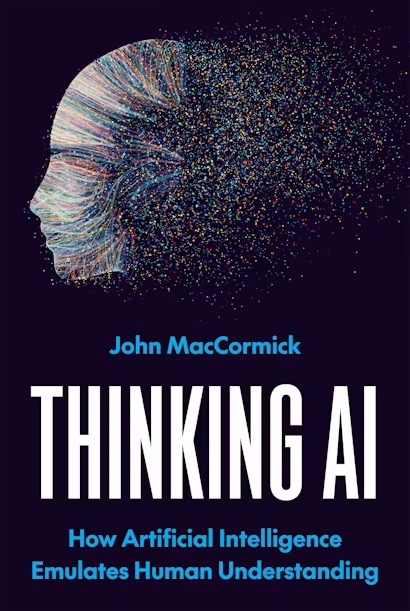
By John MacCormick
SOMETHING IS MISSING
Review by Gunnel Minett
This book by John MacCormick, a professor of computer science, asks the question: ”In what ways can computer programs appear to think like humans?” [p5] He poses the question as part of the debate around the role of AI in modern society. To answer this question he turns first to Alan Turing who asked the same question in an influential paper in 1950. This paper became central to research in artificial intelligence. To elaborate on Turing’s thinking, MacCormick offers a tour of the most famous AI systems available today. He describes how each system works, and points to parallels with human brain processes. Both human minds and computer programs, he argues, can generate intelligence through emergence: in other words, the capability for new phenomena to emerge from the interactions of many small, simple components. To illustrate this, MacCormick argues in favour of the theory of computationalism, which claim that biological brains function very much in the same way as computers. Thus, humans, animals, and machines all share the same fundamental kind of cognition. A consequence being that, yes, computers are capable of thought!
MacCormick promotes the idea that computers can think like human beings. He also suggest that both human and artificial intelligence stem from emergent processes: when a computer’s components reach a certain numerical level and complexity, the machine can emulate many, if not all, aspects of human thought. There is, however, one aspect of this claim that MacCormick carefully avoids, despite its crucial importance. Rather than asking whether machines can truly think, he prefers to ask in what ways they can convincingly seem to be doing so. Specifically he leaves out emotions, and sentience, the basic capacity to perceive, feel, and experience sensations subjectively, aspects which are essential for human thought processes.
We still have some distance to travel when it comes to learning to live comfortably with AI rather than allowing it to be take us over. But it’s already clear that understanding the difference between human and computer thinking is essential for this adjustment. Even if some principles of the processing of information are more or less the same, there are also fundamental differences. To talk to a computer may seem like a good substitute for human interaction, but as we are starting to see, it is not the same. Given the large increase in children and teenagers with psychological problems since the arrival of social media, we have to ask ourselves what the difference is between real human communication with friends and virtual interaction. The physicist and philosopher Federico Faggin explains it as; ‘the need for a soul at the other end’ rather than something that just seems to be human. And the theoretical neuroscientist Romaine Brette points to the many problems with taking a ‘computer programmer’s view’ of human behaviour in his recent book.
There are many contributions to the AI debate, though we certainly haven’t arrived at any satisfactory conclusions (if we ever do). One possible reason for this potential threat to our mental wellbeing is that AI is being developed by computer experts with, as it seems, limited understanding of the human psyche and neuroscience. To exclude emotions and sentience for the sake of simplicity, as MacCormick does in his book, simply can’t be acceptable. If we are to create AI as a useful tool rather than a harmful master, we need close cooperation between experts on all sides. And as MacCormick argues, it is when enough components work together that the potential for emergence occurs.
Princeton University Press, 2026, 282pp ISBN-13 : 978-0691191737
 breathwork-science